
Every casino site has a page like this and almost nobody reads it, because most of them read like a legal department clearing its throat. This one assumes you are an adult who plays pokies on purpose, does not need a lecture about the dangers of enjoying yourself, and would quite like to know which switches exist, where they are, and what happens when you flip them.
So here is the short version before the detail. SlotRave carries deposit limits, loss limits, reality checks, cooling-off and self-exclusion in both temporary and permanent form. Several of them are not sitting in your account menu as tick-boxes. You have to ask live chat or email support to apply them, which is a genuine weakness and one I will come back to. Australia's national self-exclusion register, BetStop, does not cover this brand and cannot be made to. And the two numbers worth saving to your phone before you read another line are 1800 858 858 for Gambling Help Online, running 24 hours a day, and 13 11 14 for Lifeline if things have gone past gambling and into crisis.
One thing holds for every tool below: they work in advance. A deposit cap set on a quiet Tuesday afternoon is still holding at 2 am on a Saturday, whereas a cap you go hunting for at 2 am is being chosen by the version of you least qualified to choose it. Timing does most of the work here. If you want the wider picture on the brand (the licence, the operator, the payout record), the SlotRave Casino Australia safety overview covers it. This page is only about control.
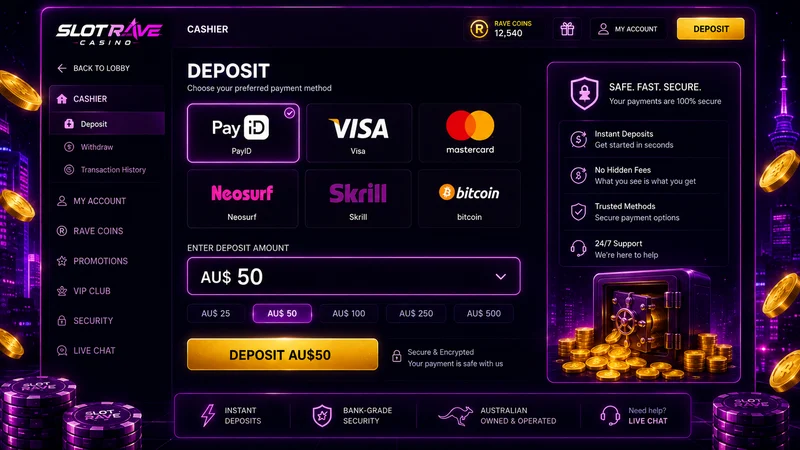
The responsible gambling tools inside your SlotRave account
SlotRave runs five categories of control. That is a reasonable spread by offshore standards, given how many Curaçao-licensed brands offer nothing beyond a self-exclusion email address, but the delivery is where it falls short. Only part of the toolkit is genuinely self-service. The rest requires you to open live chat, state what you want, and wait for an agent to apply it to the account.
| Tool | What it actually does | How you switch it on | Can you undo it? |
|---|---|---|---|
| Deposit limit | Caps how much money you can move into the account across a daily, weekly or monthly window. Play continues on whatever balance is already there. | Live chat, or email [email protected]. Ask for the exact figure and the exact window. | Tightening it takes effect on the spot. Loosening it is not instant: expect the request to sit before it applies. |
| Loss limit | Caps net losses over a set period. Once you hit the number, real-money play stops for the rest of that window even if funds remain. | Live chat request. Give the amount and the period. | Same asymmetry: down fast, up slow. |
| Reality check | A timed interruption that tells you how long the session has been running. It does not stop anything; it makes you notice. | Live chat request. | Yes, removable on request. It is the softest tool on the list. |
| Cooling-off | A short freeze. The account stays alive, you simply cannot log in and play for the length you nominated. | Live chat or email. You name the duration. | No early release. It expires by itself and the account reopens. |
| Temporary self-exclusion | A longer lock. Login blocked, deposits blocked, marketing should stop for the duration. | Email support with the word self-exclusion and the period stated plainly. | No. That is the point of it. |
| Permanent self-exclusion | Account closed for good. Not a pause, not a holiday. | Email support and say permanent, in writing, so there is a record. | No. Treat it as final and choose it deliberately. |
Now the criticism, because pretending otherwise would be useless to you. Putting a conversation in front of a limit adds friction, and friction is what a player in a bad moment tends not to push through. Better operators drop a slider into account settings, no human involved, applied on the spot. SlotRave routes several of these through support. The chat runs 24 hours so you are not waiting until Monday, and in my experience the agents apply what you ask without arguing or steering you toward a smaller number. It is still a call you have to make, though, and some people never make it.
Practical workaround: batch it. On the day you first fund the account (the process is covered step by step in the SlotRave sign-up process walkthrough), open chat once and request the whole set in a single message: deposit cap, loss cap, reality check interval. Ninety seconds and one conversation. Get an email confirmation and keep it, because if a limit ever fails to apply that email is your evidence.
SlotRave deposit limits: how to set one and why it only works in advance
A deposit limit is the single most effective control on this list, and it is effective for an unglamorous reason. It does not rely on willpower. Willpower is a resource that runs down over an evening; a cap enforced by a server does not get tired at midnight.
The mechanics are simple. You nominate an amount and a window. Once deposits inside that window reach the number, further funding is refused until the window rolls over. Existing balance is untouched, because a deposit limit is not a play limit. That trips people up. If you hold AU$600 in the account and set a AU$100 weekly deposit cap, you can still play through the AU$600. The cap governs new money entering, nothing else.
Choosing the number matters more than choosing the tool. Here is the framework I would use.
| Limit type | What it controls | How to pick the figure | The trap |
|---|---|---|---|
| Daily deposit cap | Total funded in a rolling 24 hours | One evening's entertainment budget — the same money you would spend on a night out and not think about again | It resets. A AU$100 daily cap is a AU$700 weekly cap wearing a disguise. |
| Weekly deposit cap | Total funded across seven days | The best default for most players. Pick what you can lose in a week without adjusting anything else in your life. | Front-loading — the whole week's allowance gone on Monday night, then six days staring at a locked wallet. |
| Monthly deposit cap | Total funded across the month | Set it at or below the weekly figure multiplied by four. It is a ceiling on the ceiling. | Too generous to bite. On its own it rarely does any work. |
| Loss limit | Net losses over the chosen window | Roughly half your deposit cap, so a losing run ends the session before the wallet does | It measures net position, not turnover. You can churn enormous volume and never hit it. |
Two brand-specific details worth knowing. The minimum deposit at SlotRave is AU$10, so any cap below that figure simply blocks the account entirely, which is a crude but functional cooling-off if that is what you want. And the deposit routes matter: card, PayID, e-wallet, voucher and crypto all sit behind the same account-level cap, so you cannot slip past a limit by switching from Visa to Litecoin. The full breakdown of channels and their own floors and ceilings is in the SlotRave banking options guide.
Set the limit before you claim the bonus, not after
The welcome package spreads across four deposits and rewards you for funding the account repeatedly. That is the design working as intended, and it pulls in the opposite direction to a deposit cap. Decide the cap first, then decide whether the package fits inside it. The full conditions, including the 40x wagering and the requirement to turn the deposit over three times, are set out in the SlotRave welcome bonus conditions breakdown. If the package only makes sense at a deposit level above your cap, the answer is to skip the package, not to raise the cap.
Self-exclusion at SlotRave: temporary, permanent, and what happens to your balance
Self-exclusion is the heavy tool. It does not cap anything; it removes access to the account. SlotRave offers it in both flavours, and what separates them is whether there is a road back.
Temporary self-exclusion
You nominate a period and the account locks for its duration. Login refused, deposits refused, promotional email should stop. When the period ends the account reactivates and you can log back in. Some operators require you to actively reopen the account rather than letting it spring back automatically, so ask the agent to confirm in writing which behaviour applies to yours when you request it.
Temporary exclusion suits a rough month, a run that got away from you, or a stretch where the account was open more than it should have been. Take the break, and come back with a limit already in place.
Permanent self-exclusion
The account closes, with no expiry date and no reopening it in six months because the mood passed. Request it by email so there is a written record on both sides, use the word permanent explicitly, and do not soften it with words like "for now". Ambiguity is how a permanent request becomes a temporary one in someone's ticket queue.
What happens to money in the account
Sort this out before the lock goes on, not after. The clean sequence is: withdraw first, verify identity if you have not already, wait for the funds to land, then request the exclusion. Trying to extract a balance from a locked account is a support ticket nobody enjoys, and it puts you back in contact with the casino during exactly the period you were trying to stay away from it.
Three things to check before you pull the trigger:
- Your balance clears the AU$50 minimum withdrawal. Below that, cash it out is not an option and you will need support to intervene.
- Identity documents are already approved. An unverified account cannot be paid out, and the paperwork is far more painful once the account is frozen. The requirements are listed in the SlotRave identity verification requirements rundown.
- Any active bonus is either finished or written off. A balance still carrying wagering obligations is usually forfeited on closure, and chasing 40x through to completion purely so you can leave is the worst possible reason to keep playing.
On timing: cashouts run hours for crypto, one to three business days for cards and e-wallets, and up to five for a bank transfer, which is the slowest route and the one most likely to leave you waiting while an exclusion request sits pending. Pick the fast rail. The SlotRave payout speed page has the per-method detail and the daily, weekly and monthly ceilings.
Why BetStop will not close an offshore casino
This is the most misunderstood point in Australian gambling, and getting it wrong has real consequences. So, plainly.
BetStop is the National Self-Exclusion Register. You register once, choose a period from three months to lifetime, and every operator inside its scope is legally obliged to block you and to stop marketing at you. It is free, it is government-run, and it works properly. The register is a genuinely good piece of policy.
Its scope is the catch. BetStop covers licensed Australian interactive wagering services: the domestic sportsbooks and race betting operators that hold an Australian licence and answer to an Australian regulator. That obligation exists because Australian law can reach them.
SlotRave is not one of those. It runs on a Curaçao licence under TechSolutions Group N.V., outside Australian jurisdiction. Nothing in the register's machinery reaches it. Register with BetStop and this account keeps working the next morning exactly as it did the night before.
What the Interactive Gambling Act actually does
The Interactive Gambling Act 2001 makes it an offence to offer online casino games to Australian residents without an Australian licence. The obligation sits on the operator. There is no provision in the Act penalising a player for placing a bet, and ACMA's enforcement tools are aimed outward: blocking requests to internet providers, action against operators. So the law is not going to come for you, and it is also not going to protect you. The second half of that is the one that matters on this page. Who is behind the brand and what that licence is worth is covered in the SlotRave operator and licence details profile.
The practical conclusion. If you want to be excluded from Australian betting, register at BetStop and it will hold. If you want to be excluded from SlotRave, you must request it from SlotRave directly, and there is no external body enforcing that request on your behalf. Then layer on the tools that do not depend on the casino cooperating at all: the bank block and the blocking software described further down.
Signs the game is getting away from you
No moralising here, and no checklist designed to make casual players feel guilty. These are simply behaviours that reliably show up before things get bad, drawn from what the help services actually report. Read the list, mark the ones that are true this month, and be honest, because nobody is reading your answers.
- You have deposited money that was earmarked for rent, a bill or groceries, and told yourself you would put it back after the next win.
- You are chasing. A loss is followed by a bigger stake specifically to recover the loss, not because the bigger stake was the plan.
- Sessions run longer than intended, routinely, and you are surprised by the clock when you look at it.
- You have borrowed to play, from a person, a credit card, or a buy-now-pay-later account.
- Somebody has asked how much you are playing and you gave a number that was not the real number.
- You play when you are angry, flat or stressed and it is the mood that opens the app rather than the entertainment.
- Wins do not get withdrawn. They get replayed, always, and the balance only ever goes one direction over a month.
- You have thought about limits before and not set them, because setting them felt like admitting something.
- Sleep, work or relationships have taken a hit and gambling is somewhere in the chain of why.
One or two on a rough month is human. Four or five is a pattern, and a pattern is worth a phone call, not because you have a diagnosis but because a free conversation with someone who does this all day costs you nothing and tells you more than another week of self-assessment will.
Where to get gambling help in Australia
All of the services below are free and confidential, and none of them require you to have hit a crisis before you are allowed to use them. Calling early is normal. Most people who ring Gambling Help Online are not in freefall; they are somewhere in the middle and want a plan.
| Service | Contact | Hours | What you get |
|---|---|---|---|
| Gambling Help Online | 1800 858 858 | 24 hours, every day | The national front door. Phone counselling, web chat, email support and structured online programs. Free, confidential, and staffed by counsellors who specialise in gambling rather than general wellbeing. |
| Lifeline | 13 11 14 | 24 hours, every day | Crisis support. If gambling has led somewhere darker (hopelessness, thoughts of self-harm), this is the number, and it takes precedence over everything else on this page. |
| Financial counselling | Referral through Gambling Help Online or your state's financial counselling service | Business hours, by appointment | Free, qualified help with debt: negotiating with creditors, hardship arrangements, restructuring repayments. Separate discipline from gambling counselling and often the more urgent of the two. |
| BetStop | betstop.gov.au | Register online any time | National self-exclusion from Australian-licensed wagering operators, three months to lifetime. Does not reach offshore casinos, including this one. |
| Your GP | Your regular clinic | Business hours | An underrated route. A GP can refer you into subsidised psychology sessions and treat the sleep and anxiety problems that usually travel alongside. |
What a first call is actually like, since the unknown is what stops people dialling: you are asked what has been happening, roughly how much and how often, and what you want to change. Nobody tells you to stop gambling. Nobody records your name against a register. You come off the phone with two or three concrete next steps and a standing invitation to call back.
Blocking payments at your end
Every tool discussed so far depends on the casino honouring it. These do not, which makes them the strongest options on the page for anyone who wants a barrier that does not rely on an offshore operator's goodwill.
The gambling block in your banking app
Most major Australian banks now ship a gambling transaction block, usually a toggle in the card controls section of the mobile app. Switch it on and the bank declines merchant transactions coded as gambling at the point of authorisation. The casino never sees the money because the money never leaves.
Two properties make this genuinely useful. It applies at your bank, so it survives you deciding at midnight that this particular casino should be an exception. And switching it back off is typically not instant, since most banks impose a delay of a day or more before the block lifts. That delay is precisely the friction you want.
Its blind spots are worth naming honestly:
- Crypto. Buying Bitcoin or USDT at an exchange is not coded as a gambling transaction, so the block does not see it, and crypto is an accepted deposit rail here.
- Vouchers. Neosurf and Paysafecard bought at a newsagent with cash sit entirely outside the banking system.
- Coding errors. Offshore operators are not always categorised correctly by their payment processors, and a transaction coded as a general purchase slides straight through.
- Other accounts. A block on one bank's card does nothing about a second bank, a partner's card or a digital wallet you topped up last month.
Blocking software
The other layer is device-level. Gamban and similar blockers install across your phone, tablet and computer and cut off access to gambling sites and apps at the network layer. They maintain their own lists of thousands of domains, offshore brands included, and they update as new ones appear. That matters, because manually blocking one casino just relocates the problem to the next search result.
Install on every device, not the one you consider the problem. The laptop you never play on is the laptop you will play on the night the phone is blocked. Some services are free through state gambling help programs, so ask before you pay for one.
Stacked properly the layers run: casino-side limits and self-exclusion, then the bank-side transaction block, then the device-side software block. Each one on its own has a hole in it somewhere. Together they hold.
Helping someone else
If you are here about another person rather than yourself, the instinct is almost always to lead with money or ultimatums. Both tend to backfire. What follows is closer to what actually works.
Worth doing:
- Pick a calm moment. Not mid-session, not straight after a loss, not while either of you is angry.
- Describe what you have noticed rather than what you have concluded. "You have been up until three most nights this fortnight" lands. "You have a gambling problem" starts an argument about the label instead of the behaviour.
- Protect your own finances. Separate accounts, remove yourself as a guarantor, check whether joint credit is exposed. This is not disloyalty; it is the thing that keeps you able to help at all.
- Offer the practical steps: sit with them while they call 1800 858 858, help install the blocker, be in the room when they message support to request a self-exclusion. Company beats advice.
- Call Gambling Help Online yourself. They counsel family members, not only players, and you are allowed to ring about someone who has not asked you to.
Worth avoiding:
- Paying off gambling debts. It removes the consequence and reliably recurs. Financial counselling addresses the debt without underwriting the next round.
- Monitoring and policing. It turns you into an adversary and drives the activity underground rather than reducing it.
- Ultimatums you will not enforce. One unenforced threat teaches that none of them are real.
- Making it a character verdict. Shame does not reduce gambling; it reduces how much you get told about it.
The maths worth keeping in your head
Not a scare tactic, just arithmetic, and the honest version is more useful than either the casino's framing or the doom-laden one.
Every pokie carries a built-in margin. A game with 96% return to player pays back AU$96 for every AU$100 wagered across an enormous sample, and keeps AU$4. That AU$4 is the house edge. There is no trick in it and nothing hidden; it is how the business exists, the same way a pub charges more for a schooner than the beer cost it.
The consequence people miss is what turnover does to that margin. The edge applies to every wager, not to your deposit. Money that comes back and gets bet again is taxed again.
| Spins at AU$1 | Total turnover | Expected loss at 96% RTP | At 94% RTP | At 90% RTP |
|---|---|---|---|---|
| 500 (about an hour) | AU$500 | AU$20 | AU$30 | AU$50 |
| 2,000 (a weekend) | AU$2,000 | AU$80 | AU$120 | AU$200 |
| 10,000 (a month of evenings) | AU$10,000 | AU$400 | AU$600 | AU$1,000 |
| 40,000 (clearing a AU$1,000 bonus at 40x) | AU$40,000 | AU$1,600 | AU$2,400 | AU$4,000 |
That last row deserves a moment. Wagering here runs at 40x the bonus amount, so a AU$1,000 bonus obliges you to push AU$40,000 through the games before the balance converts. At a 4% margin the mathematically expected cost of that journey is AU$1,600, which is more than the bonus itself. Variance means individual players finish ahead; the average does not, and it is not close. That is the arithmetic behind every "the bonus was impossible to clear" complaint, and it is also why the loyalty scheme detailed on the SlotRave VIP levels page rewards turnover so generously. Turnover is the product.
None of which means do not play. It means playing with the number in view: your expected outcome over a long enough run is negative, sessions where you finish up are variance rather than skill, and the only variable genuinely under your control is how much turnover you generate. That last one is why this page spends its length on limits.
Set your limits in the accountFAQ
Does SlotRave offer self-exclusion?
Yes, in both temporary and permanent form. Temporary locks the account for a period you nominate and lifts automatically when it expires. Permanent closes the account with no route back. Request either through live chat or by emailing [email protected], and state the type and duration explicitly so there is no ambiguity in the ticket. Withdraw any balance and complete identity verification before the lock goes on, because extracting money from a frozen account is considerably harder than emptying it first.
Is SlotRave covered by BetStop?
No. BetStop, the National Self-Exclusion Register, binds Australian-licensed interactive wagering operators only. SlotRave runs on a Curaçao licence under TechSolutions Group N.V. and sits outside Australian jurisdiction, so registering with BetStop has no effect on this account whatsoever. To be excluded here you must request it from SlotRave directly. For a barrier that does not depend on the operator, add a bank-level gambling transaction block and device-level blocking software.
What responsible gambling tools does SlotRave offer?
Five categories: deposit limits on a daily, weekly or monthly window; loss limits capping net losses over a period; reality checks that flag elapsed session time; cooling-off periods that freeze the account briefly; and self-exclusion, temporary or permanent. The weak point is delivery: several are applied by a support agent on request rather than toggled by you in account settings, which puts a conversation between you and the limit. Live chat runs 24/7, so ask for the whole set in one message rather than tool by tool.
Where can I get gambling help in Australia?
Gambling Help Online on 1800 858 858 is the national service, free, confidential and staffed around the clock, offering phone counselling, web chat and structured online programs. Lifeline on 13 11 14 handles crisis support if things have moved beyond gambling itself. Free financial counselling is available by referral for debt problems, and your GP can refer you into subsidised psychology sessions. None of these require a crisis before you are entitled to use them.
Can I set a deposit limit at SlotRave?
Yes. Contact live chat or support by email, specify the amount and whether it applies daily, weekly or monthly, and ask for written confirmation. Tightening a limit takes effect immediately; loosening one is not instant, which is the behaviour you want. The cap governs money entering the account, not money already in it, and it applies across every deposit channel, so switching from card to crypto will not route around it. Keep the confirmation email, because if a limit ever fails to hold that record is your evidence.