
Nobody signs up to a casino thinking about paperwork. You come for the pokies, you get a match on your first deposit, and the document upload page is something you scroll past in the account menu for weeks without opening. Then you win, you press withdraw, and a grey banner appears telling you the account requires verification before funds can be released. That is the moment most Australians meet SlotRave KYC verification for the first time, and it is the worst possible moment to meet it.
The instinct at that point is to assume the casino is stalling. It is a reasonable instinct. An offshore brand holding a Curaçao licence, operated by TechSolutions Group N.V., disclosing almost nothing about itself, suddenly wants a photo of your driver licence before it hands over your money. But the demand is not invented by this operator and it is not discretionary. Every licensed gambling business on earth runs identity checks, because a business that takes money from unidentified people is a laundry and no regulator can permit that. Casinos differ on how competently and how quickly they run the checks. None of them skip them.
So this page skips the policy recital. It covers exactly which documents SlotRave accepts, how to photograph them so they clear on the first submission rather than the third, what the anti-money-laundering side of the operation is watching for, and what to do when a submission is knocked back with a message that explains nothing. For the broader picture on the brand itself (games, licensing, who runs it), the SlotRave Casino Australia verification overview covers that ground. Everything below is documents, checks and compliance.
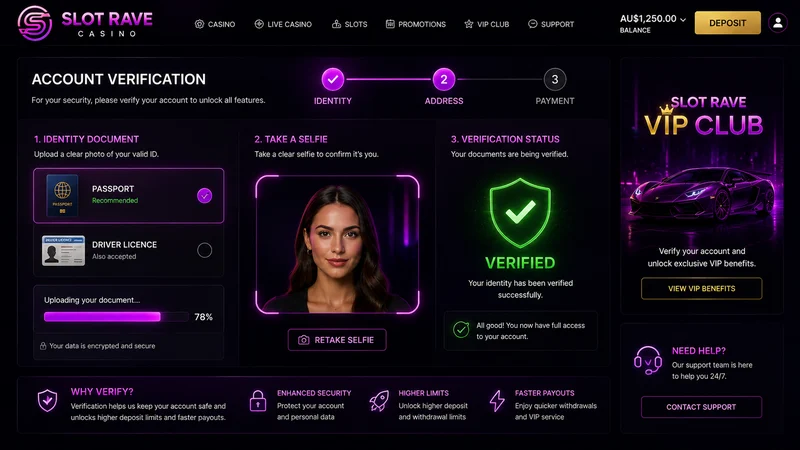
What KYC and AML actually mean — and why they are not the same thing
The two acronyms get used as if they were interchangeable. They are not, and understanding the difference tells you why some requests feel routine and others feel intrusive.
KYC, or Know Your Customer, is the one-off gate. It answers three questions: are you a real person, are you who you say you are, and are you old enough. It happens once, near the start, and once it is passed it stays passed. Photo identification, proof of address, evidence that the payment account belongs to you. That is the whole scope. A passed KYC check is a permanent state on your account, not something you redo every month.
AML, or Anti-Money Laundering, is the permanent one. It never finishes. It is a monitoring layer sitting underneath every deposit, every bet and every cashout you make for as long as the account exists, watching how your money moves. AML is what generates the awkward mid-relationship questions: where did this come from, why did the pattern change, why are you depositing in a way that looks engineered.
Players who realise this stop being surprised by the timing. You can be fully verified for eight months, playing AU$20 sessions without a single question, and then trigger a source-of-funds request the week you deposit AU$4,000 in an afternoon. Nothing broke. The identity gate and the monitoring layer are separate systems, and the second one only ever speaks up when your behaviour changes.
The full SlotRave documents required checklist
Five categories, and only the first two are universal. The third applies to almost everyone, while the last two are exception-driven. Prepare the lot anyway. A scanned bank statement sitting in a folder costs you nothing, while hunting for one with a payout on hold costs several days.
| Document type | What is accepted | What is not accepted | Most common rejection reason |
|---|---|---|---|
| Photo identification | Australian passport photo page; state driver licence, both front and back as separate files; a state-issued proof-of-age or photo card; Keypass card | Medicare card on its own; student ID; a photocopy of a photocopy; a licence that expired last month | Only one side of the licence uploaded — the back carries the card number the reviewer needs |
| Proof of address | Electricity, gas, water or internet bill; council rates notice; bank or credit-union statement; correspondence from the ATO — all dated inside the last three months | Anything showing a PO box; a document addressed to a partner or parent; a rates notice from two years ago; a screenshot of an app dashboard | Document older than 90 days, or an address that does not match the account profile character for character |
| Payment ownership | Card photo with the first six and last four digits visible, middle eight covered, signature strip and CVV masked; e-wallet profile page showing your name and account email; a bank statement header with your name and the BSB; a crypto wallet address you can sign from | Full sixteen digits in frame; a card in a spouse's name; a wallet registered under a nickname or a shortened first name | Card image cropped so tightly that the embossed name is cut off |
| Selfie or liveness check | A clear photo of your face holding the same ID document you uploaded, both readable in one frame | Sunglasses, hat, heavy backlight, a photo of a screen showing your face | The document in the selfie is too small or too blurred to read, so it cannot be matched |
| Source of funds | Recent payslips; a full bank statement covering the deposits made; a contract of sale; superannuation or dividend statements | Partial pages; screenshots with balances cropped out; documents that do not reconcile with the amounts deposited | The evidence does not add up to the money that went in |
One rule sits above all five rows and there is no negotiating it: the account holder, the identification, the address document and the payment instrument must all be the same person. A shared household card, a wallet opened years ago under a maiden name, a joint account where your partner is listed first: each of these turns a five-minute check into a fortnight of correspondence. Fix the mismatch at the SlotRave signup form field by field stage, where the fields are still editable and the money is not yet involved.
Open your account and verify earlyHow to capture a document so the SlotRave KYC process clears it first time
Here is the part almost every guide skips, and it is the part that decides your outcome. The overwhelming majority of failed submissions are photography problems rather than eligibility problems. The document was perfectly valid; the reviewer simply could not read it.
The reviewer on the other end is looking at a compressed image on a screen, often at a fraction of full size, and they are working through a queue. They are not going to squint, rotate and enhance your photo to give you the benefit of the doubt. If a digit is ambiguous, it gets bounced. Work through this list before you upload anything:
- All four corners inside the frame, with margin. A licence with the top edge clipped is an automatic rejection, because a cropped document is exactly what a doctored document looks like. Leave a visible border of desk on every side.
- Shoot in daylight, never with flash. Modern Australian licences and passports are laminated and holographic. A flash produces a white blowout across precisely the area holding your date of birth. Face a window, put the document flat, and let the natural light do it.
- Kill the shadow of your own phone. Hold the camera slightly off to one side instead of directly overhead, and check the preview for a dark band across the middle before you tap.
- Every character must be legible at full zoom. Open the photo, pinch in on the document number, the expiry date and your name. If you cannot read them comfortably, neither can the reviewer.
- Colour, always. Greyscale scans are treated as suspect because colour is one of the security features being checked. If you are using a home scanner, set it to colour at 300 dpi and nothing lower.
- Check the expiry date before you upload, not after. An expired licence is the single most avoidable rejection there is, and it burns a full review cycle.
- Photograph the original, never a screen. A photo of a laptop displaying a PDF of your bill will be rejected on sight, because moiré patterns and screen glare are unmistakable.
- Keep files under a few megabytes in JPG, PNG or PDF. A 25 MB raw image from a modern phone will often fail the upload silently, leaving you convinced you submitted something you never did. Reduce it before sending.
- One document per file, named plainly. Front and back of a licence go up as two separate files. A single image with both halves side by side confuses the automated matcher.
Follow that list and my modelled run through the process looked like this: licence front and back plus a March electricity bill submitted on a Tuesday morning, a green verified badge on the account before the same day was out. Skip it and you get the pattern that fills complaint threads everywhere: three submissions across six days, each rejected with a single unhelpful line, and a payout sitting frozen the whole time.
Proof of address: which Australian documents clear
Address verification trips up Australians more than identification does, mostly because the documents we treat as normal are not always the documents a compliance desk treats as normal. The test a reviewer applies is simple: was this issued by a recognised third party, does it show your full name and residential address together, and was it issued recently.
| Australian document | Verdict | What to watch |
|---|---|---|
| Electricity, gas or water bill | Strongest option | Download the PDF from the retailer's portal rather than photographing a paper copy; make sure the issue date is on the same page as the address |
| Council rates notice | Accepted, very reliable | Annual issue means it ages out fast — useless from about month four |
| Bank or credit-union statement | Accepted | Must be the issued statement, not a transactions screenshot; you may mask balances but never the name, address or date |
| ATO correspondence, including a notice of assessment | Accepted | Redact your tax file number before uploading — no casino needs it and no legitimate one will ask |
| Internet or landline bill | Usually accepted | Fine on paper, occasionally queried because these are the easiest bills to forge |
| Mobile phone bill | Risky | Frequently refused outright — a mobile service is not tied to a physical dwelling |
| Rental ledger or signed lease | Sometimes accepted | Works better when it carries an agency letterhead and a date |
| Medicare card, insurance card, loyalty mail | Not accepted | No issue date, no verifiable address, no chance |
| Anything showing a PO box | Not accepted | Residential address only; a postal box proves nothing about where you live |
Three months is the window, and it is measured from the issue date printed on the document rather than the date you downloaded it. A bill generated in January and uploaded in May fails even though you sent it this morning. If you have recently moved, update the address in your profile before submitting the new document. A mismatch between profile and paperwork reads as a red flag, and the reviewer has no way to tell it apart from a house move. Same street, same spelling, same unit number format on both. "Unit 4/22" and "4/22" are not the same string to an automated matcher.
The ten minutes that saves you a week
Verify on the day you register, while your balance is empty and nothing is at stake. There is no cost to being verified early and no benefit whatsoever to leaving it. Upload at signup and the whole thing is a formality you barely remember afterwards. Upload at cashout and it feels like the operator holding your winnings hostage, even though the casino, the process and the documents are identical. The only thing that changed is when you did it. Details on how those checks sit inside the wider account rules are in the SlotRave account verification clauses.
Source of funds: when SlotRave asks where the money came from
A source-of-funds request feels like an accusation. It usually is not. SoF sits above ordinary identity checking and it fires on amounts and patterns rather than on suspicion of you personally. The operator publishes no threshold, and no figure appears anywhere in the public terms, so the honest answer to "at what amount does it kick in" is that nobody outside the compliance team knows. The shape of the triggers is observable, though.
Requests cluster around a few situations. Deposits that jump sharply from your established pattern, say months of AU$50 top-ups followed by a AU$5,000 card deposit. Cashouts approaching the published ceilings, which sit at AU$6,000 a day, AU$24,000 a week and AU$75,000 a month; a player working through those caps week after week is moving serious money and will be asked about it. Funds arriving by a rail with limited traceability. And deposit volume that does not sit comfortably against the profile you gave at signup.
What satisfies a request is documentation that reconciles. Payslips covering the period, a full bank statement showing the money leaving your account and going in, a contract of sale for a car or a property, a dividend or superannuation statement. The word doing the work is reconciles: if you deposited AU$12,000 across a fortnight, the evidence needs to account for AU$12,000, not for a plausible-sounding income in general. Partial pages, cropped screenshots and statements with the balances blanked out will be returned every time.
Two things not to do. Do not deposit through a third party to sidestep the question, because a payment instrument that does not carry your name fails on its own and turns a routine query into a genuine investigation. And do not answer with a narrative when a PDF would do; nobody is reading your explanation, they are checking whether the numbers line up. Which rails leave the cleanest paper trail is set out under the SlotRave card and crypto deposit options.
How long SlotRave KYC takes — and how to shorten it
The operator publishes no service level for verification, which means any specific number you read is either someone's individual experience or an invention. What can be described accurately is the structure of the wait, because that is what you can influence.
A clean first submission (correct documents, readable images, names matching) is typically reviewed within a business day. A resubmission is not a continuation of that review; it is a fresh one, dropped at the back of the same queue. That is the mechanic that turns a one-day process into a week. Three rejected uploads is not three days, it is three full cycles plus your own turnaround time in between, and if one of those lands on a Friday you have bought yourself a weekend as well.
The levers that genuinely move the timeline, in order of impact:
- Submit everything at once. ID, address and payment ownership in a single pass. Feeding documents through one at a time means one review cycle per document.
- Get the photography right. Image quality is the dominant rejection cause, and it is entirely within your control before you press upload.
- Verify before you have a balance. Removes the queue from in front of your money altogether.
- Upload on a weekday morning AEST. Compliance desks are staffed unevenly and a Friday-night submission tends to sit.
- Use live chat to confirm receipt. Support runs 24/7 and can tell you within a minute whether a file arrived and is queued, which is far better than staring at an unchanged status page for a day.
- Fix only what was flagged. Reuploading the entire set when one document was rejected reopens checks that had already passed.
The payoff is direct. Verification is the largest single component of the slow-payout reputation attached to this brand, and it is the component with the most player control. Clear it early and the cashout queue behaves the way the SlotRave cashout queue and pending payouts page describes rather than the way the complaint threads do.
Upload your documents in the cashierWhy SlotRave verification failed: the fix for each rejection
Rejection messages tend to be one line long and tell you almost nothing. Here is the translation table, mapping what you were told to what actually went wrong and what to send back.
| Reason for rejection | What is really wrong | How to fix it |
|---|---|---|
| "Document not legible" | Glare, motion blur, or resolution too low to read the numbers | Reshoot flat, in daylight, no flash; zoom in yourself to confirm every character before uploading |
| "Document incomplete" | A corner or edge is outside the frame | Reshoot with visible desk margin on all four sides; never crop to the document border |
| "Document expired" | The licence or passport is out of date | Use a current document; an expired one cannot be accepted under any circumstances |
| "Address mismatch" | Profile address differs from the document, sometimes by a formatting detail | Correct the profile first, match the format exactly, then resubmit |
| "Proof of address too old" | Issue date is outside the three-month window | Download the current month's bill or statement from the provider's portal |
| "Name does not match" | Married name, shortened first name, missing middle name, or a genuinely third-party account | Send a change-of-name certificate or marriage certificate; a third-party payment instrument cannot be fixed, only replaced |
| "Payment method not verified" | Card image cropped, masking done wrong, or the wallet screenshot shows no name | Reshoot with the embossed name and first six / last four digits visible, middle eight and CVV covered |
| "Selfie does not match" | The document in the selfie is unreadable, or lighting obscures your face | Retake in even daylight, no hat, no glasses, document held steady and readable in the same frame |
| "Additional documents required" | An AML flag was raised, not a KYC failure | This is a source-of-funds request in disguise — respond with reconciling financial evidence |
| Repeated rejection with no clear reason | Something structural on the account, often a duplicate registration | Ask live chat for the specific field that failed, in writing; duplicate accounts must be resolved before anything else moves |
One pattern worth naming: if you have been bounced three times with the same generic message, stop resubmitting. You are burning review cycles on a guess. Open live chat and ask which specific field failed and what the reviewer needs to see. A named answer costs you two minutes and saves you three more cycles of the same mistake.
What happens to your documents after you upload them
You are handing a photograph of your driver licence to an offshore company. That deserves a clear-eyed look rather than reassurance, so here is the honest position.
Uploads travel over an encrypted connection and are stored on the operator's systems, where the compliance function can reach them and general support staff cannot. That is the standard arrangement across licensed casinos, and nothing about this brand suggests it falls short of it. Nothing publicly verifiable suggests it goes further either: no third-party security certification is published, no data protection officer is named, and no retention schedule carries a number. What the operator states about handling and retention is set out in the SlotRave privacy policy and data retention notice, and it is worth ten minutes of your attention before you upload.
Sensible precautions, which cost you nothing:
- Redact anything the check does not require: a tax file number on an ATO notice, account balances on a statement, the middle digits of a card.
- Upload only through the account's own document page, never as an email attachment, and never in a chat window. Support will not ask you for documents by email; anyone who does is not support.
- Keep your own copies of exactly what you sent and when. If a dispute arises later, "I submitted the March electricity bill on the fourteenth" is a fact you can evidence.
- Use a unique password on the account and enable any additional login protection offered. The documents are only as safe as the credentials guarding them.
The realistic assessment: this is a Curaçao-licensed operator with limited public disclosure and a Safety Index of 5.8, rated below average. That is not a reason to refuse verification, since every casino requires it and refusing simply means no payout. It is a reason to send the minimum viable set of documents, redact what you can, and treat the upload page as something other than a filing cabinet.
AML monitoring: the transactions that raise questions
The monitoring layer is not watching your win rate and it does not care whether you are up or down. It is watching for shapes that resemble money laundering, and several of those shapes are things ordinary players do without a second thought.
| Pattern | Why it flags | What a normal player should do instead |
|---|---|---|
| Structuring — several deposits just under a round threshold in one session | The classic laundering signature; splitting to stay under a reporting line | Make one deposit of the full amount. Four AU$900 top-ups look far worse than a single AU$3,600 |
| Deposit and immediate withdrawal with negligible play | Using a casino balance as a transit account rather than to gamble | Nothing to do here — the 3x deposit turnover condition makes this impossible at this brand anyway |
| Third-party payment instruments — a partner's card, a friend's wallet | Breaks the chain between account holder and money; also a plain terms breach | Only ever use an instrument in your own name, in both directions |
| Mixed or obscured crypto — funds routed through a mixer or a chain-hopping service | Deliberately destroying traceability, which is the definition of the offence | Deposit from a mainstream exchange wallet you control and can prove ownership of |
| Sudden escalation — AU$50 sessions for months, then AU$5,000 in a day | Profile no longer matches behaviour | Expect a source-of-funds request and have the statement ready before you deposit |
| Many rails at once — five different methods across a week | Layering across instruments to break the audit trail | Pick one or two rails and stay with them; it also speeds up your payouts |
| Duplicate accounts on one household or device | Bonus abuse and identity concealment in one move | One account per person, ever. This is the fastest route to confiscation there is |
| Refusing a documentation request | Non-cooperation is itself a reportable indicator | Respond, even if only to ask precisely what is needed |
The important nuance: a flag is a query, not a verdict. Most are cleared by one document. What turns a query into a frozen account is evasion: ignoring the request, sending deliberately partial evidence, or trying a different payment method to get around it. Answer plainly and it goes away. Keep in mind too that a bonus can shape your deposit pattern in ways monitoring notices, since chasing a four-part welcome package pushes people into rapid sequential deposits; the structure of that offer is broken down under the SlotRave first deposit bonus and its 7-day clock.
Your rights, and what to do when you disagree
You are entitled to a few things during verification, and it helps to know what they are before you need them.
You are entitled to know which specific document failed and why, in terms concrete enough to act on. "Rejected" is not an answer; "the expiry date is not legible" is. Ask for that in writing through live chat, which runs around the clock, and keep the transcript. You should also be told what is still outstanding, in one go, instead of discovering it an item at a time. And nobody should be asking you for material with no bearing on identity or source of funds: a tax file number, a full unredacted card, or your login credentials for another service are all things to decline and query.
When you disagree with an outcome, escalate in order rather than in volume. Start with live chat and get the reviewer's specific objection on record. Move to email at [email protected] within a day or two, attaching what you sent and when, because email creates the dated written trail that everything afterwards depends on. If that stalls, write a formal complaint stating the account, the dates, the documents submitted, the responses received and the resolution you want. Only then go external: the Curaçao licensing authority is the formal route for an operator holding that licence, and public complaint platforms carry real weight because a brand sitting at a below-average safety rating with no formal complaints on record has an obvious interest in keeping it that way.
What will not help is an Australian regulator. Under the Interactive Gambling Act 2001 the prohibition falls on the offshore operator rather than on you as a player, and the ACMA's power is to block websites, not to recover funds. BetStop, the national self-exclusion register, covers Australian-licensed operators only and has no reach here, so any exclusion you need has to be set through the account itself, using the tools described under SlotRave self-exclusion and reality check settings. If chasing a verification outcome has stopped being about the money and started being about the chase, that is the signal to step back; Gambling Help Online is free, confidential and available on 1800 858 858 at any hour.
Get verified before your first cashoutFAQ
What documents does SlotRave require for KYC?
Photo identification, meaning an Australian passport, a state driver licence with both sides uploaded separately, or a state photo card. Then proof of address issued within the last three months, such as a utility bill, council rates notice, bank statement or ATO correspondence. Most accounts are also asked for evidence that the payment method belongs to them: a card photo with the middle eight digits masked, or an e-wallet page showing your name. Larger cashouts can additionally trigger source-of-funds documents. Every name and address must match the account profile exactly.
How long does SlotRave KYC take?
The operator publishes no service level, so treat any exact figure with caution. A clean first submission with all documents sent together and photographed properly is usually reviewed inside a business day. The problem is that a rejected document does not resume the review; it starts a new one at the back of the queue, so three bounced uploads can easily become a week. Submitting everything in one pass, in colour, in daylight, with all four corners in frame, is what separates a same-day verification from a multi-day one.
Why do casinos require KYC verification?
Because a gambling account that accepts money from an unidentified person is a money-laundering vehicle, and every licensing regime requires operators to prevent that. The checks also enforce the minimum age rule and stop payouts being routed to somebody other than the account holder, which is the main defence against account takeovers. Licence conditions require it, so no casino, offshore or otherwise, can waive it for you, and any site offering to is a site with much bigger problems.
What is AML in online casinos?
Anti-Money Laundering is the ongoing monitoring layer that watches transaction patterns rather than identity. Where KYC is a one-off gate you pass at the start, AML runs continuously for the life of the account, looking for shapes associated with laundering: deposits split just under round thresholds, payment instruments in other people's names, funds arriving through mixers or chain-hopping services, sudden escalation away from your established pattern, or several rails used in quick succession. A flag produces a request for documents, and nobody is accusing you of anything; the accounts that get frozen are the ones that ignore the request.
Can I withdraw before verification?
No. A first payout is not released until identity and address checks have passed, and at this brand there is a second gate as well: the deposit turnover condition applies regardless of whether you took a bonus. Because most players only begin uploading once they already have winnings waiting, verification is the single biggest contributor to the slow-payout complaints attached to this casino. Doing it on the day you register costs about ten minutes and removes the delay entirely.